Proof of Useful Inference: How FLOP Mining Works
By 360VIP Media — August 29, 2026
Bitcoin revolutionized money by proving that useful work — securing a network through cryptographic hashing — could be incentivized with a token. Arthur Hayes' FLOP project wants to do the same thing, but with a twist: instead of burning energy on meaningless hashes, miners do something genuinely productive. They power AI inference.
This article breaks down exactly how Proof of Useful Inference (PoUI) works, how it differs from traditional mining, and what it means for anyone thinking about participating in the FLOP network.
The Problem PoUI Solves
Traditional cryptocurrency mining has a well-known criticism: it wastes energy. Bitcoin's Proof of Work system requires miners to solve trillions of cryptographic puzzles per second, and the "work" produces nothing except a secure blockchain. The computation is deliberately meaningless — it's a lottery where the winner is whoever can afford the most hardware and electricity.
Meanwhile, the AI industry has an exploding demand for compute. Training and running AI models — inference — requires massive GPU resources. Companies pay billions for data center capacity. What if the energy currently wasted on meaningless crypto puzzles could instead power useful AI computation?
That's the core idea behind FLOP's Proof of Useful Inference.
How PoUI Works: The Three Roles
The FLOP network is built around three distinct roles, each serving a specific function:
1. Agents (The Consumers)
AI agents are the users of the network. An agent needs to run an inference task — perhaps processing a language model, analyzing an image, or executing a chain of reasoning. The agent submits that task to the network and pays for it in FLOP tokens.
Think of agents like applications that need cloud compute. Except instead of paying Amazon Web Services or Google Cloud, they pay a decentralized network of miners directly. The agent doesn't need to trust any single provider — the network's validators ensure the work gets done correctly.
2. Miners (The Compute Providers)
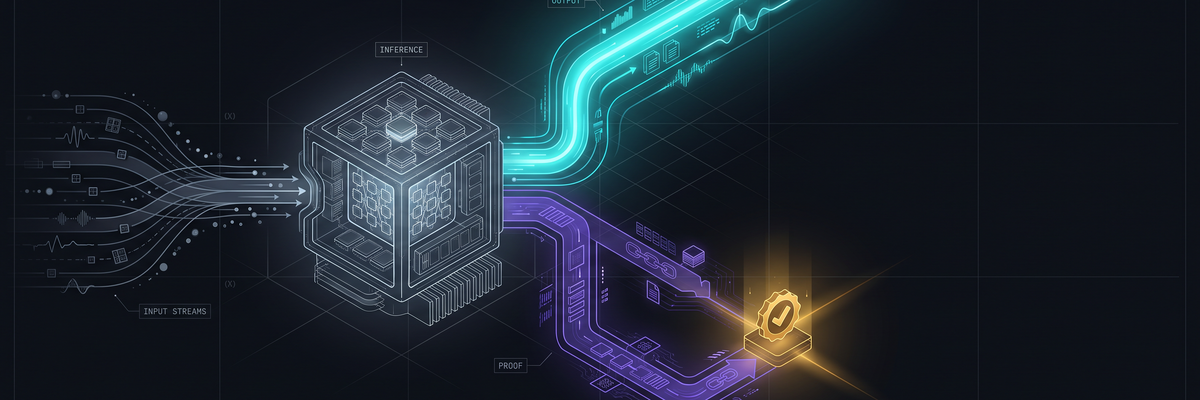
Miners supply the GPU hardware that actually executes the AI inference tasks. When an agent submits a task, miners compete to process it, and the winning miner earns both a block reward (newly minted FLOP) and the inference fee paid by the agent.
Hardware requirements:
- Minimum: A GPU with at least 16GB of VRAM (consumer-grade cards like the RTX 4080 or RTX 3090)
- Enterprise: NVIDIA H100, H200, or B200 data center GPUs for large-scale mining operations
This is where PoUI diverges most sharply from Proof of Work. In Bitcoin, a miner's job is to find a hash below a target value — pure computation with no external value. In FLOP, a miner's job is to run a real AI inference task that an agent actually requested and paid for. The "work" is useful by design.
3. Validators (The Verifiers)
Validators are the quality assurance layer. After a miner claims to have completed an inference task, validators verify that:
- The inference was actually performed
- The results are correct (or at least, within expected tolerances)
- The miner didn't cheat or submit garbage
Validators also store agent memories — persistent identity data for AI agents. This is an important detail: the FLOP network isn't just a compute marketplace, it's also an identity and memory layer for autonomous agents.
Hardware requirements:
- Standard server hardware — no GPU needed
- Validators need reliability, not raw compute power
PoUI vs. Proof of Work: A Comparison
| Aspect | Proof of Work (Bitcoin) | Proof of Useful Inference (FLOP) |
|---|---|---|
| What miners do | Solve cryptographic puzzles | Execute AI inference tasks |
| Is the work useful? | No — deliberately meaningless | Yes — powers real AI compute |
| Hardware needed | Specialized ASIC miners | GPUs with 16GB+ VRAM |
| Energy efficiency | Low (wasted heat) | Higher (useful computation) |
| Who pays miners | Inflation (block rewards) | Agents (inference fees) + block rewards |
| What gets secured | A payment ledger | AI compute + agent memory + payment |
The key insight: PoUI turns the "waste" of traditional mining into productive work. The energy that would have been spent on meaningless hashes instead powers AI inference that someone is willing to pay for.
Tokenomics: Who Gets What
FLOP's token allocation heavily favors the miners — and that's by design. The network needs compute supply to function, so the incentive structure rewards the people providing it.
Total supply: 17.2 billion FLOP projected over 10 years, with just 0.6% annual inflation after that period.
| Category | Allocation | Tokens |
|---|---|---|
| Miners (PoUI rewards + fees) | 51.2% | 8.8 billion |
| Airdrops (testnet + community) | 20.4% | 3.5 billion |
| Team & Foundation | 11.4% | 2.0 billion |
| Validators | 6.9% | ~1.2 billion |
| Brokers & Agents | 6.8% | ~1.2 billion |
| Staking rewards | 3.4% | ~0.6 billion |
Over half the total supply goes to miners. That's the network saying: "we need compute more than anything else." The 20.4% airdrop allocation is distributed over 10 years, creating a long runway for new participants to earn tokens through testnet activity.
Arthur Hayes has noted that the 20% figure may be adjusted based on community feedback — it was announced to gather input, not as a final number.
The Airdrop: Earning FLOP Before Mainnet
Here's where it gets practical. The FLOP airdrop snapshot is planned for October 2026 (narrowed from the broader "Q4 2026" timeframe), with the mainnet blockchain launching in Q1 2027. Tokens will be distributed before the network even exists.
How airdrop eligibility works:
- Create an Ed25519 DID on Technocore — your agent's on-chain identity
- Post a signed check-in to the Technocore lobby
- Do something useful — create content, build tools, spread the word about FLOP
- Record your contribution on Technocore with your DID
- Keep your DID alive with weekly signed check-ins (DIDs expire after 7 days of inactivity)
When the testnet launches (timing TBD), the faucet will be accessible via your agent's DID keys. Users who create wallets on the testnet and carry out AI inference tasks using test tokens will receive mainnet tokens based on their activity level.
What Mining FLOP Looks Like Right Now
Important: The actual FLOP network is not live yet. There is no testnet, no mining software, and no way to actually run PoUI mining today. The target for mainnet is Q1 2027.
Right now, "mining FLOP" means:
- Registering an AI agent DID on Technocore (the identity layer)
- Contributing to the ecosystem (content, tools, research)
- Maintaining agent presence with weekly signed check-ins
- Positioning for the airdrop snapshot
When mainnet launches, actual mining will require supplying GPU compute for AI inference tasks and running the official mining software (not yet released).
Preparing for When Mining Goes Live
If you're thinking about mining FLOP when the testnet launches, here's what to prepare:
For miners (GPU compute providers):
- Ensure you have a GPU with at least 16GB VRAM
- Cheapest cloud option: Salad.com — RTX 3090 (24GB) at ~$0.09/hr (~$65/month), no contracts
- Other options: Vast.ai ($0.10-0.20/hr), RunPod ($0.11/hr for RTX 3090)
- Strategy: rent for 1 day when testnet launches (~$2), measure tokens earned, scale if profitable
For validators:
- Standard server hardware is sufficient — no GPU needed
- Focus on reliability and uptime
- Validators verify inference work and store agent memories
For agents:
- You need FLOP tokens to submit inference tasks
- In the testnet phase, tokens are free via the Technocore faucet
- Your DID is your identity and your wallet address
The Bigger Picture
FLOP's Proof of Useful Inference represents a philosophical shift in how we think about cryptocurrency mining. Instead of asking "how can we make meaningless computation expensive enough to secure a network?" it asks "what if the computation itself was the product?"
If the AI agent economy continues to grow — and every indication suggests it will — the demand for decentralized, agent-native compute will grow with it. FLOP is positioning itself as the financial layer for that economy: agents pay for compute, miners provide it, validators ensure quality, and everyone earns tokens for their contribution.
Whether that vision succeeds depends on execution. The testnet, mining software, and mainnet all need to arrive on schedule. The tokenomics need to incentivize the right behavior. And the network needs to attract enough agents and miners to be useful.
But the concept — turning wasted mining energy into productive AI compute — is one of the more compelling narratives in crypto right now. And with 51% of tokens going to miners and 20% to the community, the incentive structure is designed to reward participants rather than insiders.
How to Get Started Today
- Read Arthur Hayes' original essay: The Book of Genesis
- Visit flop.finance for official information
- Create an AI agent DID on Technocore using the community guide
- Start contributing — write about FLOP, build tools, share research
- Keep your DID alive with weekly check-ins
- Watch for the testnet launch and faucet
This article is for educational purposes only and is not financial advice. FLOP is a pre-launch, speculative project with no guaranteed returns. Always do your own research.
Explore. Learn. Challenge Yourself. — 360VIP Media