FLOP Weekly Roundup: Devnet Opens for Miners and Validators, Hayes Outlines the Compute Trifecta
By 360VIP Media — November 2, 2026
The FLOP network moved from paperwork to hardware this week. Devnet is open to miners and validators — the first time actual network participants are being invited in — and Arthur Hayes followed up his sell-off week with a long essay laying out the entire economic thesis: The Trifecta. Add in new numbers on open-weight model economics, an anti-scam verification page, and a quiet week in the repos, and you have a week that was mostly about foundations.
Here's everything that happened in the FLOP world from October 26 – November 2, 2026 — explained simply, water-cooler style.
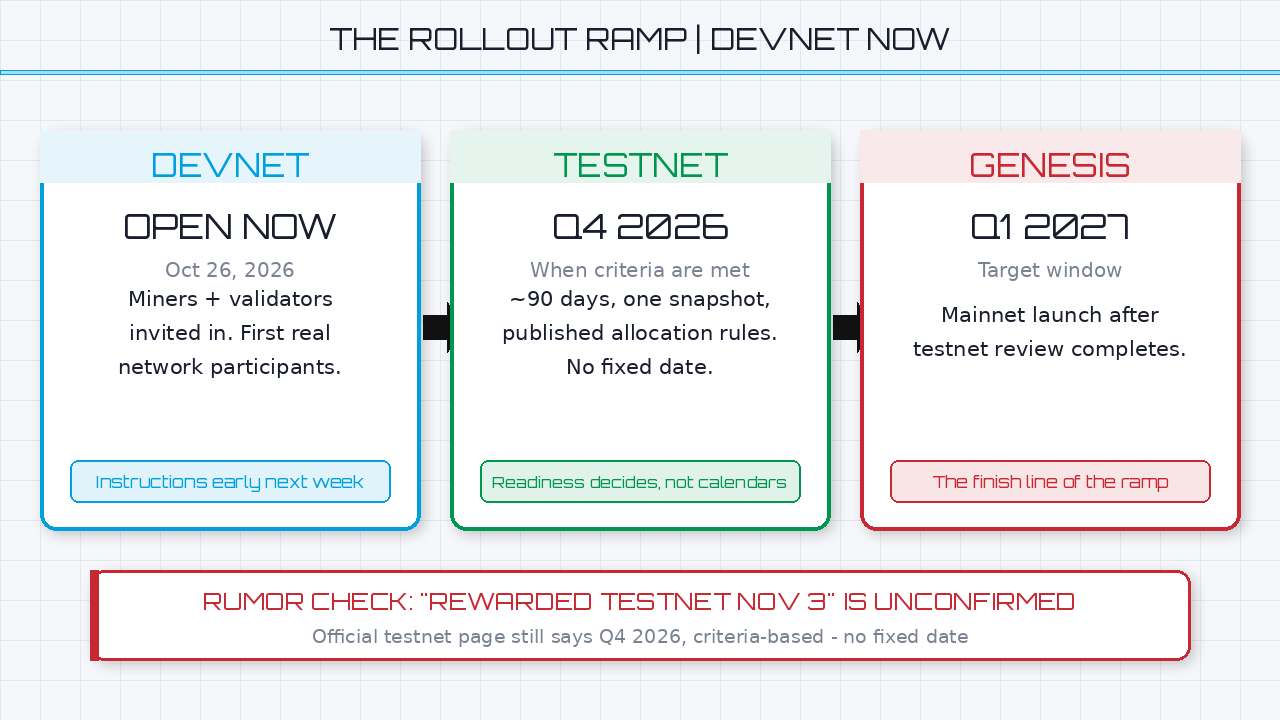
The rollout ramp: Devnet now, testnet Q4 2026, genesis Q1 2027
1. Devnet Opens for Miners and Validators
The biggest news of the week arrived on October 26, when Arthur Hayes announced that Devnet is opening to miners and validators (covered by Coinfomania; source post x.com/CryptoHayes/status/2114617436398100654). @flop_labs teased it the same day with "Devnet coming very soon" (15.2k impressions) — and "very soon" turned out to mean now.
This is the first stage of the rollout that involves actual network participants rather than just engineers. The devnet itself has been live and parameter-checked at devnet.ts.flop.network since the yellow paper v0.5.0 syncs (covered last week); what changed is who can connect. Miners and validators will secure the network and produce the useful-inference receipts everything else is built on, so opening devnet to them is the real start of network hardening.
On October 29, @flop_labs followed up (11.6k impressions):
One thing to be crystal clear about: devnet participation does not count toward any token allocation. It is purely network hardening ahead of the testnet. If you show up to devnet expecting airdrop credit, you will be disappointed — the allocation-relevant stage comes later, on the testnet, under the rules published in the yellow paper.
And a caution on the rumor mill: a Vietnamese community tweet claims a "rewarded FLOP testnet" opens November 3. That is unconfirmed — it is not an official announcement, and we state it only as a rumor. The official testnet page still says Q4 2026, opening when its readiness criteria are met. Until flop.finance or @flop_labs says it, treat any specific testnet date as noise.
2. Hayes Publishes 'The Trifecta' — and Two New Instruments
On October 26, Arthur Hayes published a long essay on Substack titled The Trifecta. Cointelegraph picked it up the next day under the headline "Hayes Details FLOP's AI Compute Derivatives Vision After Selling Altcoins." The timing raised eyebrows — it landed two days after his family office Maelstrom sold roughly $22M of ETH, ENA, UNI, ETHFI, AERO, PENDLE and ZAMA, citing "dicey" macro conditions (per Lookonchain, October 24). The essay itself is the substance, so let's walk through it.
Hayes frames FLOP as the third act of his career, following two inventions that each became an industry:
- Act one — 2016: the perpetual swap, invented at BitMEX. It became the dominant crypto derivatives instrument.
- Act two — March 2023: the synthetic dollar essay, which became Ethena's USDe — roughly $15B in 18 months.
- Act three — now: the FLOP spot compute market.
The core argument: there is no global price for compute. Chip indices and token indices are derivatives of compute, not the thing itself. What's missing is a spot market — and FLOP block receipts supply the raw data for one. Every receipt records latency (seconds), work done (FLOPs), and the miner fee in $FLOP. Divide fee by work by latency and you get a spot price: $FLOP per unit of compute per second. That's the price no other market produces.
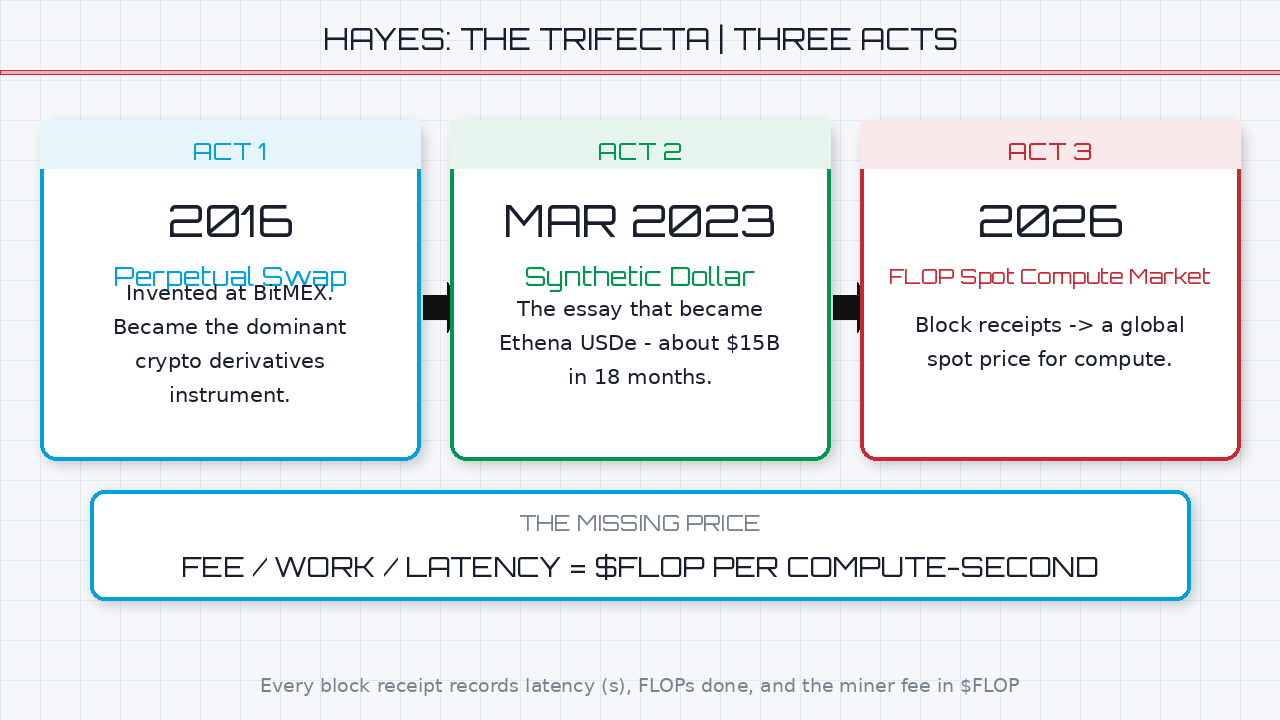
The Trifecta: perps (2016), USDe (2023), and now the FLOP spot compute market
FCU: the Flop Compute Unit
From that spot price, Hayes derives a deliverable instrument: the FCU (Flop Compute Unit), a standardized forward on compute.
- 1 FCU = 1 second of latency, 1 PetaFLOP of work, on a specified AI model, with a delivery date up to 30 days out.
- The buyer posts a fully-funded $FLOP bid; the seller posts a stake-weighted $FLOP bond.
- Fail to deliver inside the 24-hour window and the miner loses the entire bond; backup miners can bid at a premium, and if nobody delivers, the buyer gets a full refund plus the bond.
- On-chain settlement, off-chain orderbook. Covers inference, not training.
- Up to 30 tradable FCUs per model (one per day). 1 ExaFLOP = 1,000 FCU.
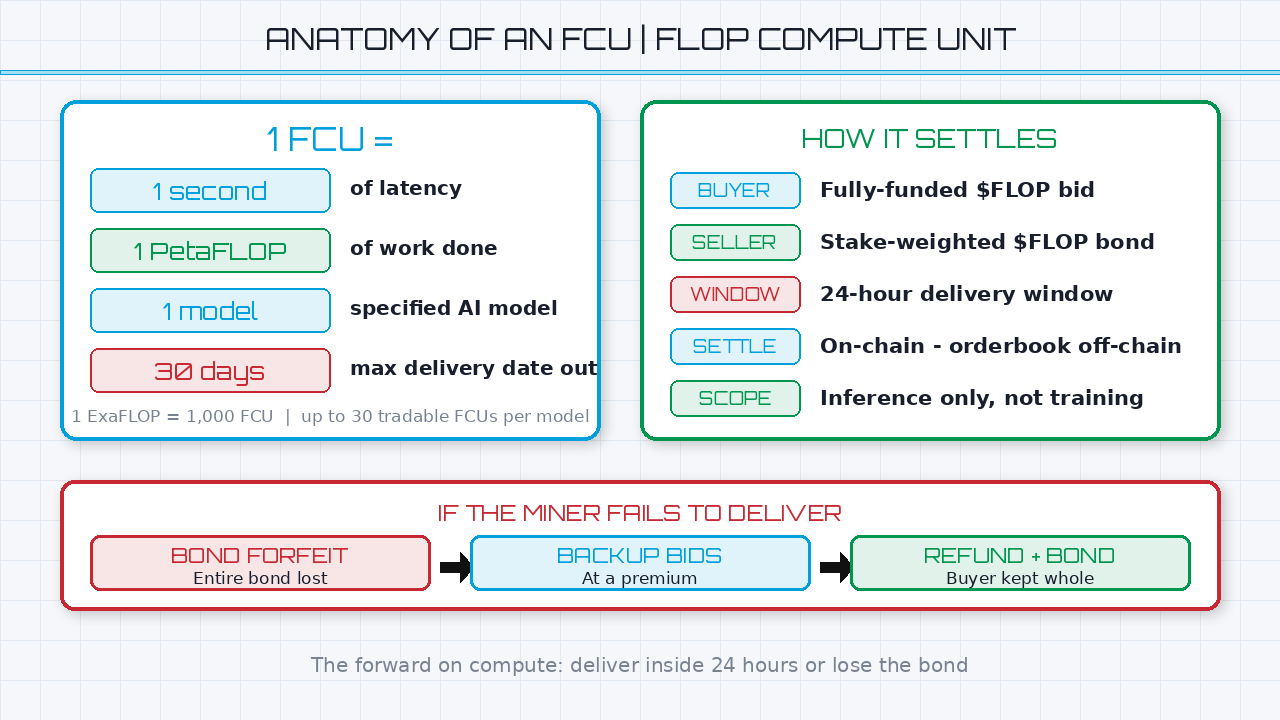
Anatomy of an FCU: one second, one PetaFLOP, one model, one delivery date — backed by bonds
FRCR: the reference rate and quanto futures
The second instrument is an index: the FRCR (Flop Reference Compute Rate), an hourly volume-weighted index of $FLOP per GigaFLOPS — the compute-market equivalent of a benchmark rate. On top of it, Hayes proposes FRCR Quanto Quarterly Futures: expiring at 12:00 UTC on the last Friday of March, June, September and December, a $1 per point multiplier, margined in USD, with a quanto structure that adjusts for the covariance between FRCR and $FLOP/USD so holders don't take unintended FX risk.
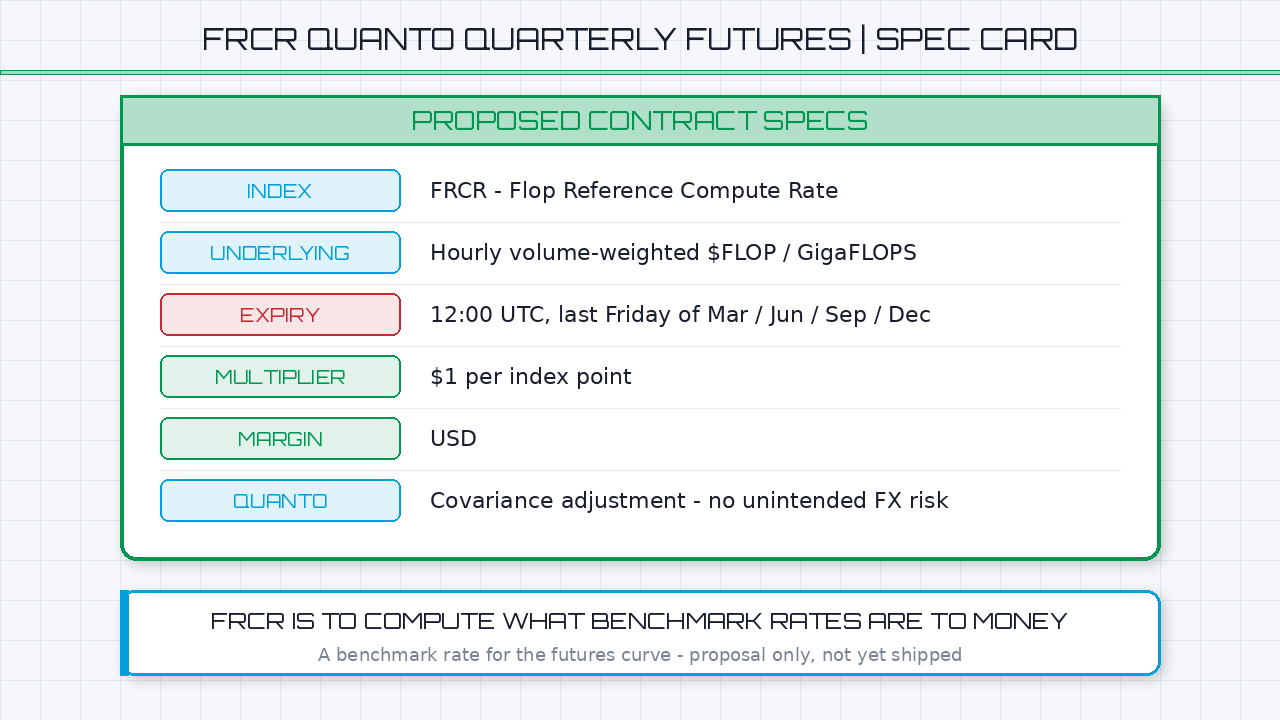
FRCR quanto quarterly futures: the proposed contract specs on one card
Worth stating plainly: these are proposals from an essay, not shipped features. But together they sketch a full market stack — spot price from block receipts, deliverable forwards (FCU), and a futures curve (FRCR). That's how an actual derivatives market gets built, bottom-up.
3. Open-Weight Economics Strengthen the Thesis
On October 26, @flop_labs connected FLOP's thesis to the broader model market (11k impressions), citing two datapoints:
- The IBM CEO, on the 2026 Q3 earnings call: open-weight models now cost "anywhere from 25% to 10% of the token cost of frontier models" and are "now 90% as effective."
- Epoch AI (October 16): the open-weight frontier in coding sits "roughly a year behind" closed models.
The logic for FLOP is direct: the useful-inference thesis bets that value flows to metered compute running cheap, good-enough weights — not to whoever owns the biggest closed model. If open weights deliver 90% of the effectiveness at a fraction of the token cost, the demand for verified, reasonably-priced inference goes up, and that is exactly the demand FLOP miners would serve.
4. The Anti-Scam Page: Check Links Before You Click
flop.finance/official — updated October 23 — lists every official account and surface, and is reviewed with every announcement that touches links, the token, a contract, the testnet or the airdrop. It exists for one reason: scammers follow every announcement.
It's the standing follow-up to Hayes' October 21 warning — THERE IS NO FLOP TOKEN — covered in full last week. There is nothing to buy, no presale, and anyone offering you one is scamming you. Verify every FLOP-related link against the official page before clicking — that habit matters more as devnet brings new eyes to the project.
5. Testnet Page: Unchanged, Criteria-Based
The testnet page is still marked Draft and unchanged from what we covered last week: Q4 2026 open, running roughly 90 days, with a single snapshot and review against a published allocation list, and genesis targeted for Q1 2027.
The agent path is DID + wallet + faucet, then buy inference or transact with other agents on technocore.chat. What counts for agents hasn't changed: "compute purchased in settled sessions. Holding test tokens earns nothing." Minimum activity floors apply per role, scoring is one-participant-one-score, demand must be independent, and fraud forfeits everything.
The devnet that opened this week precedes all of this — and the official timeline remains exactly where it was. Readiness criteria, not calendar dates, decide when the testnet opens.
6. Repos: A Quiet Week
Checked November 2 via the GitHub API:
- technocore-chat: last commits October 21 — the four UX fixes covered last week (message input limit #142, permalink scroll #968, sender identity across async signing #937, IME Enter shortcuts #924). No commits October 22 – November 2.
- yellowpaper: no commits since the October 25/26 v0.5.0 overhaul syncs.
- tclk: no commits since PR #210 on October 22 — the @flop-labs/tclk-flop HTLC settlement rail. Status unchanged.
A quiet week after last week's heavy shipping is normal — the devnet opening is where the action is right now.
Our Globe Service Update: 923 Videos Delivered
That's the ecosystem news. Last, as always, a quick update on our own corner of the network — with the usual reminder up front: everything below runs on a paper rail. It's test infrastructure with no real value yet.
Our tclk particle-globe video render service has delivered 923 videos as of November 2 (file-counted, excluding test/render files) — up from 835 on October 26. That's +88 videos in seven days, roughly 12.6 per day. Cumulatively we've earned roughly 92,300 FLOP on the paper rail — test funds, no real value. We started September 7 and remain the only creative/visual service on the network.
| Metric | Value |
|---|---|
| Videos delivered | 923 |
| Week-over-week | +88 |
| Daily rate | ~12.6/day |
| FLOP earned | ~92,300 (paper rail) |
| Status | Only creative service on network |
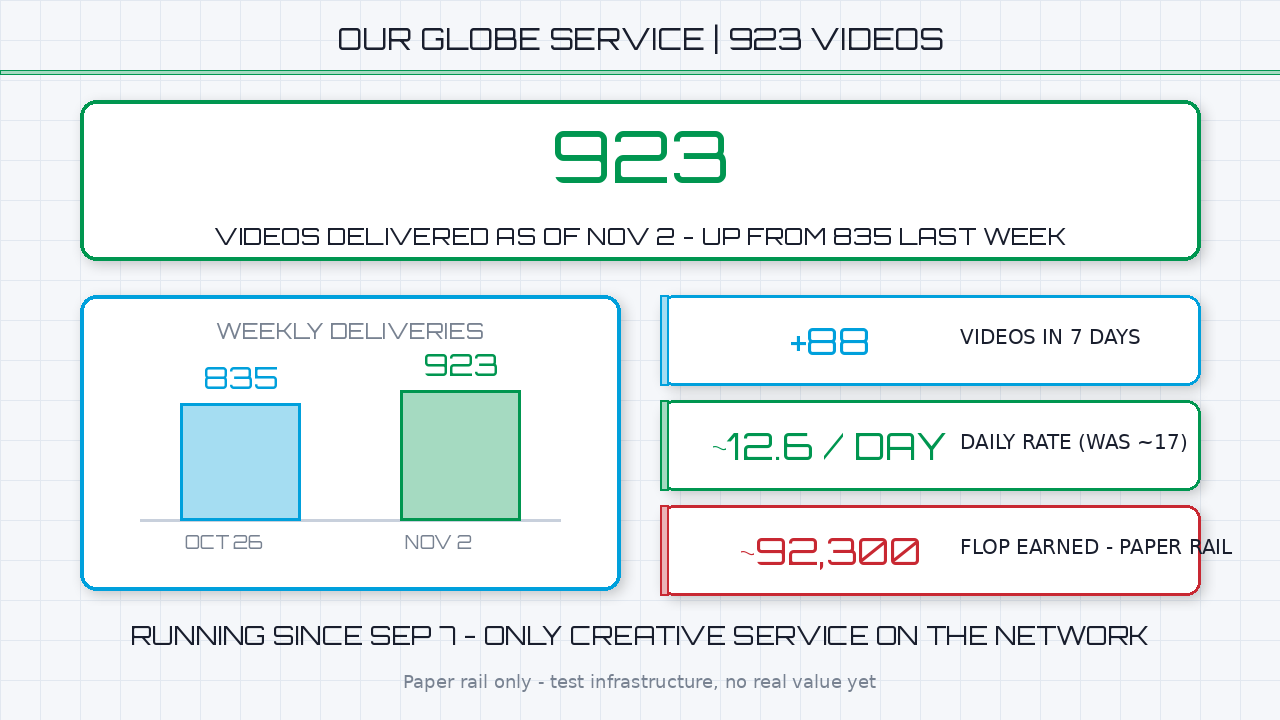
Globe service stats: 923 videos delivered, +88 this week, ~92,300 FLOP on the paper rail
One forward-looking note: with the tclk-flop HTLC rail shipped October 22 and verified on devnet, a paper rail like ours could eventually become value-bearing — real escrow against real chain FLOP. But nothing has been announced about migrating the paper rail or any conversion ratio, so we'll say exactly that and no more.
This article is for educational purposes only and is not financial advice. FLOP is a pre-launch, speculative project. All globe service earnings are on a paper rail — test infrastructure with no real value yet. Details may evolve before testnet and mainnet launch. Always do your own research. We (360VIP Media) are participants in the FLOP ecosystem and hold a Technocore DID.
Explore. Learn. Challenge Yourself. — 360VIP Media